
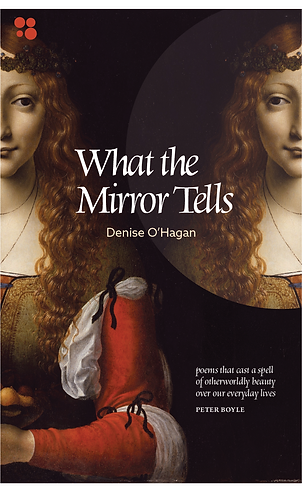
What the Mirror Tells
POEMS
Denise O'Hagan
Publication date
ISBN:
August
2026
978-1-923248-29-8
About the author
Denise O’Hagan is a Sydney-based poet and editor of New Zealand background, born and raised in Italy. She has a Masters in Bibliography and Textual Criticism and a background in commercial book publishing in Routledge, Collins and Heinemann (London) and Horwitz, Cambridge University Press and the State Library of NSW(Sydney).
She set up her own imprint, Black Quill Press, in 2015 through which she assists independent authors and published Jerome & His Women(2015), shortlisted for the inaugural Institute of Professional Editors’ Rosanne Fitzgibbon Editorial Award, A Roman Death (2017), Chinese Whispers (2018) and Messages from the Embers (2020). She is also the author of the Mini Style Guide: An Introduction to Good Writing and Manuscript Presentation (2018).
Her poetry is published widely, and her awards include the Dalkey Poetry Prize, the Monica Taylor Poetry Prize and the NSW Poetry Prize. She is co-editor on The Marrow International Poetry.
What the Mirror Tells is her third poetry collection.
About the book
Can conversations linger after their speakers are gone, curtains hang more heavily on some days, or we recall what we never knew? What the Mirror Tells invites us into a world where mini-fictions meet memoir, where commonplace objects acquire a curious and often unsettling edge. These are poems of implication and suggestion, reverberating sequences in which reflections speak as eloquently as fact, where a young bellringer brings the houses outside to shuddering point; the knowledge held by a hallway mirror outlasts its owner; and ancestral presences are as alive as a paediatric surgeon in a Boston hospital—and far more capricious. Whether it is the act of perception which brings about such transformation, or whether the objects or situations themselves are innately transformative, the reader must decide.
In What the Mirror Tells, Denise O’Hagan’s unmistakable voice plays medium to unsettling encounters with memory, imagination, and the feminine occult, inviting us to glimpse secrets hidden beyond human understanding.
While O’Hagan speaks for the figures of just-out of-focus women in a voice that glides as easily through centuries as a ghost, her subjects remain grounded by the quotidian: cleaning, shopping, preparing a meal, while they “cleave to an inward fountain.”
Most arresting is O’Hagan’s unflinching yet tender engagement with what the reader might have once thought of as death. This extraordinary collection is an act of devotion to the ones behind “the glassy veil between their world and ours” where “the rag-ends of conversations still rustle around” and our attention is drawn variously to a saint’s head, a marble statue, a bell tower, a child’s mossy grave, a missing woman’s coat or a charity shop “mirror taking everything in.” The address is startlingly intimate. The dead are far from it.
—AUDREY MOLLOY
The poems in What the Mirror Tells take on the theme of memory and how the past informs and charges the present. The work is exquisite, simultaneously delicate and powerful, with such apt observation that each poem conjures some thing universal while remaining tender and intimate. I love the precision of images; for example, “a looking glass looking / the other way. As if it could turn on itself, expunge itself, / leave in place a faint trace of itself” or “The moon is pouring her light down/and it’s falling about the beautiful rubble.” These are poems formed by place, space, location, and person with a mindfulness that provides a sudden sense of liberation from time and space limits.
—MAGDALENA BALL
From its first poem, What the Mirror Tells powerfully conveys the wonder of life on earth, delicately observed and transformed into sound-images. There is a strong painterly quality to much of O’Hagan’s work, matched by great precision and evocative richness.
These are deeply moving poems. We are placed inside the lives of others caught vividly in subtle and engaging language. Whether it is the death of a parent, the terror of a mother with a child in major surgery, or the story of an unknown child buried in a local graveyard, compassion, urgency and absolute clarity place us inside these experiences.
Equally arresting are the many ekphrastic poems that cast a spell of otherworldly beauty over our everyday lives. O’Hagan lets us see what art in all its forms can offer us: “You unlocked a part of me and raised it up,/and it felt lustrous.”
—PETER BOYLE
Is there a digital version available?
No
Yes